Are 1:18 Scale F1 Models Worth Collecting?
Last Updated: November 2, 2026
Quick Summary
The best 1:18 scale f1 models for modern-era collectors are race-specific resin replicas such as Spark’s McLaren MCL39 and Red Bull RB21 grand prix winners, typically priced at £150-£190. They offer sharp decals and accurate proportions, but sealed bodies with no opening panels.
- Spark’s 1:18 range is sealed resin, so there are no opening doors or engine covers.
- A 1:18 car is roughly 30cm long and needs about 32cm of internal case length.
- A 1:43 car is roughly 10-13cm long, so three or four fit in one 1:18 footprint.
- Chipped endplates and lifted decals are the two most common condition faults on used models.
- Dazsmodels offers free UK delivery on orders over £30.00.
Table of Contents
- Why 1:18 Scale F1 Models Appeal to Collectors
- The Best Spark F1 Models in 1:18 Scale
- Minichamps 1:18 F1 Models: A Collector’s Guide
- 1:18 vs 1:43 F1 Models: Which Scale Suits Your Display?
- Choosing 1:18 Scale F1 Model Display Cases
- What to Check Before Adding a Model to Your Collection
- Frequently Asked Questions
Why 1:18 Scale F1 Models Appeal to Collectors
A 1:18 replica of a modern Formula 1 car is a substantial display piece, big enough to show wing endplates, halo geometry, brake ducts and livery decals clearly.
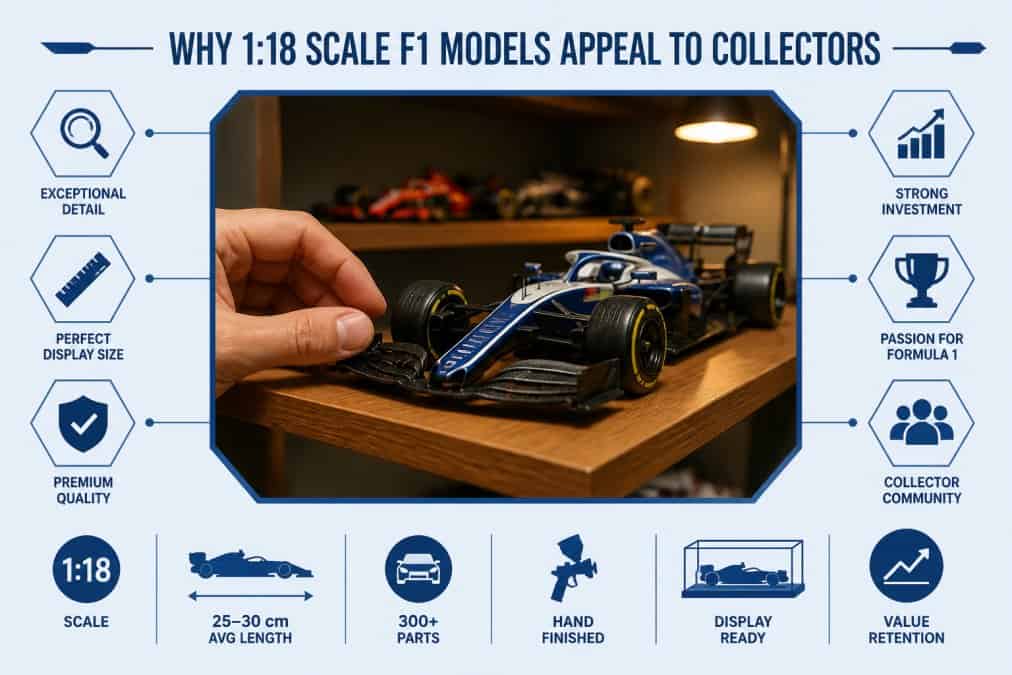
A 1:18 scale model is a replica built at one-eighteenth of the real car’s size, large enough to carry fine detail across the bodywork, cockpit and wheels. That size is the whole argument.
What most guides miss is that 1:18 is a display scale first and a collectible second. Buyers choose it because it looks right in a cabinet, not because it is rare.
The Best Spark F1 Models in 1:18 Scale
Spark is a well-known name in modern-era 1:18 collecting. For collectors chasing current-season machinery, the best Spark F1 models are resin replicas tied to specific grands prix, which gives each piece a story beyond the livery.
Three releases show the pattern:
- McLaren MCL39, Belgian GP 2025 winner, Oscar Piastri (18S1112) – a 1:18 resin replica of the Spa-winning car, with the high-downforce wing package visible.
- Oracle Red Bull Racing RB21, US GP 2025 winner, Max Verstappen (18S1113) – the same race-specific approach applied to Red Bull’s late-season form.
- McLaren MCL39 #4, British GP 2025 winner, Lando Norris (18S1010) – a home-win car that carries obvious sentimental weight for British collectors.
You can browse the Spark McLaren MCL39 Belgian GP winner to see how much detail Spark packs into the resin bodywork. The Verstappen RB21 is equally worth checking the Oracle Red Bull Racing RB21 US GP replica, and the Norris car is available to view the McLaren MCL39 British GP winner.
How we compare these three on the same rubric
Rather than rank by livery alone, score each release against four criteria that matter at 1:18: accuracy of proportion, finish and decal quality, construction and opening features, and value against indicative pricing. The table below applies the same rubric to all three so the trade-offs are visible.
| Model | Accuracy of proportion | Finish and decals | Construction and opening features | Indicative price (GBP, checked November 2026) |
|---|---|---|---|---|
| McLaren MCL39, Belgian GP 2025 winner, Oscar Piastri (18S1112) | High, Spa high-downforce wing package correctly rendered | Sharp livery printing; check sidepod decals on arrival | Sealed resin body; no opening panels | Typically £150-£190 |
| Oracle Red Bull Racing RB21, US GP 2025 winner, Max Verstappen (18S1113) | High, late-season aero spec | Matte and gloss contrasts hold up well | Sealed resin body; no opening panels | Typically £150-£190 |
| McLaren MCL39 #4, British GP 2025 winner, Lando Norris (18S1010) | High, home-race spec | Union-flag and sponsor decals are the fragile points | Sealed resin body; no opening panels | Typically £150-£190 |
Prices depend on quantity, release, and availability; please check Dazsmodels’s website for current prices or a quote. The rubric is deliberately simple so you can apply it to any Spark release, not just these three.
Construction and opening features: what you actually get
Spark’s 1:18 range is resin, which buys thinner wing elements and crisper decal edges than die-cast at the same scale. The trade-off is that the bodywork is sealed: there are no opening doors, engine covers or removable nose sections. If opening features are non-negotiable, a die-cast release from another maker is the better route; if surface accuracy and race-specific livery are the priority, resin wins.
Authenticity, licensing and packaging
Before buying any model, check that the model code on the box matches the listing and that the decals sit flat and are sharply printed. Keep the original box and any certificate, as they help protect resale value and make authenticity easier to prove later.
Photograph the box label and base plate when the model arrives. It takes a minute and gives you a record if you later sell or need to query a condition issue.
Best for: collectors who want race-specific modern cars. Skip if: you only collect metal-bodied models or need opening panels, since Spark’s 1:18 range is sealed resin.
Minichamps 1:18 F1 Models: A Collector’s Guide
The trade-off is timing. Minichamps tends to work further back in F1 history and reissue classic liveries, so its range suits collectors building a historic grid rather than chasing this season’s cars. A common mistake is assuming every Minichamps release is die-cast; the range has shifted over the years, so check the material listed for the specific model before buying.
Where Minichamps wins is authenticity of proportion on older cars. Where it loses is availability, because popular historic releases sell through and reappear only as reissues.
1:18 vs 1:43 F1 Models: Which Scale Suits Your Display?
The choice between 1:18 vs 1:43 F1 models comes down to space versus detail. A 1:43 car is roughly 10-13cm long, so you can fit three or four in the footprint of a single 1:18 model.
If you have a single glass cabinet and want impact, go 1:18. If you want a full grid across multiple seasons, 1:43 is the practical answer.
Seeing the same car in both scales settles it quickly. The McLaren MCL39 constructors’ championship set in 1:43 sits directly alongside the 1:18 Piastri Belgian GP car, and the 1:43 Oscar Piastri Belgian GP winner shows how much detail survives the size drop.
| Scale | Typical Length | Detail Level | Display Space | Best For |
|---|---|---|---|---|
| 1:18 | ~30cm | Highest | Large cabinet | Hero cars, focal displays |
| 1:43 | ~10-13cm | High | Shelf or small cabinet | Full grids, multiple seasons |
Choosing 1:18 Scale F1 Model Display Cases
A display case protects the two things that lose value fastest: decals and clear coat. Dust is abrasive, and sunlight fades livery printing over time, so a sealed case with UV-filtering acrylic is worth the outlay on any model you intend to keep.
Match the case to the car’s footprint, not the shelf, and allow clearance for the rear wing and airbox. Avoid handling the model by the wings; lift from the chassis or the base.
Watch out: stacking cases or placing them near a radiator causes resin to warp and decals to lift, and that damage is permanent.
What to Check Before Adding a Model to Your Collection
Before buying, verify four things: the material, the race or season the car represents, the driver, and whether the listing shows the actual box and packaging. Original packaging with the correct edition labelling protects resale value and confirms authenticity.
Assessing a used model’s condition
For used models, ask for photographs of the wing endplates, the decals along the sidepods, and the base plate. Chipped endplates and lifted decals are the two most common condition faults, and neither is cheap to fix. Work through this checklist before you commit:
- Paint and clear coat: look for swirl marks, dull patches and any touch-up that does not match under angled light.
- Decals: check for lifting edges, silvering and fading, especially on sidepods and the nose.
- Wings and mirrors: endplates, front-wing elements and mirrors are the most fragile parts; ask for close-ups of each.
Authenticity and licensing checks
Licensed replicas carry maker branding, a model code and consistent labelling on box and base. Match the code on the box to the listing, check that decals are sharp rather than blurred, and be wary of listings that show a stock image but describe a rare release. Keep the box, certificate and any paperwork; they are the simplest proof of authenticity if you later sell.
Choosing by budget, display space and collecting goal
Use your goal to narrow the field before you compare individual models:
- First-time buyer: one hero car in 1:18, boxed and licensed, gives the best introduction without committing to a grid.
- Focused collector: pick a driver or team and stay within it; race-winning releases hold interest and are easier to justify.
- Display-led shopper: measure the cabinet first, a 1:18 F1 car needs roughly 32cm of internal length and clearance above the airbox, then choose the car that fits the space rather than the other way round.
- Budget-conscious: set a ceiling in GBP before browsing; race-winning replicas sell through quickly, so confirm stock and current price before committing.
Availability is the other check. Race-winning replicas sell through quickly, so confirm stock before committing. Dazsmodels offers free delivery to UK destinations on orders over £30.00 and attends major automotive events across the UK where collectors can view models in person.
Frequently Asked Questions
What are the best 1:18 scale F1 models for collectors?
Many collectors look to established 1:18 scale F1 manufacturers when building a collection. Look for models of championship-winning cars, current-season liveries, and limited editions. Collectors often favour models with opening features, accurate decals, and realistic cockpit details. Availability varies, so checking specialist retailers like Dazsmodels for stock and new releases is a good starting point.
What is the difference between Spark and Minichamps F1 models?
Different 1:18 F1 manufacturers can differ in construction and detail focus, so check the material and features listed for each model. Your choice depends on whether you value opening features or maximum shape accuracy.
How big is a 1:18 scale F1 model car?
A 1:18 scale F1 model is noticeably larger than a 1:43 scale model, which makes 1:18 a popular choice for collectors who want a centrepiece.
Are 1:18 scale F1 models worth collecting?
For many collectors, 1:18 scale F1 models offer excellent value because they combine size, detail, and presence. They are ideal for display and can appreciate in value if they are limited editions or represent iconic cars. However, they cost more and take up more space than smaller scales. If you have the room and appreciate fine detail, they are a rewarding addition to any collection. Assess your budget and display space before committing.
Collecting 1:18 scale F1 models rewards patience and a clear plan, whether you chase race winners or build a historic grid. If you want to inspect the detail before committing, Dazsmodels offers a curated range of racing replicas, free UK delivery on orders over £30, and the chance to view models in person at automotive shows. Get started with Dazsmodels and find the piece your display has been missing.
